How to Deal With Anxiety Before a Flight
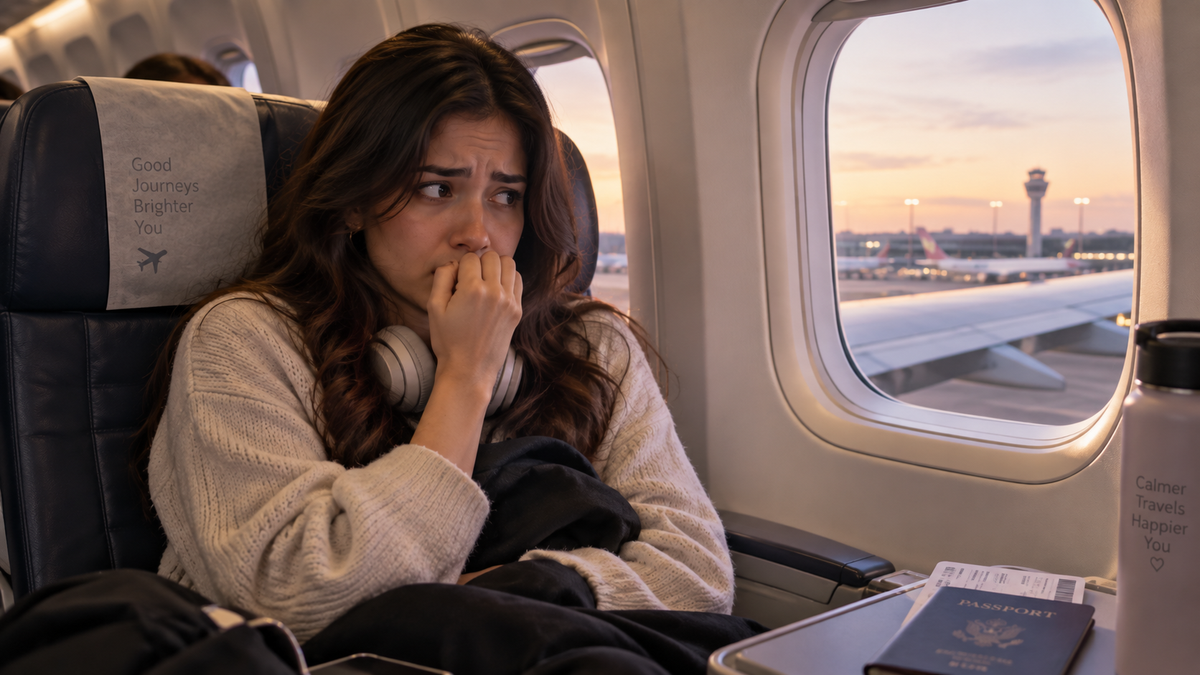
Your Heart Is Racing and the Plane Hasn't Even Left the Gate
Why pre-flight anxiety happens, and what actually helps when your body won't settle down
It usually starts the night before.
You pack your bag, check your ticket twice, and set three alarms. Then you lie awake running through everything that could go wrong. A late cab. A long security line. Turbulence. A strange noise from the engine that nobody else seems to hear. By the time you reach the airport, you're already exhausted, and you haven't gone anywhere yet.
If this sounds like a familiar scenario, then there are many others out there just like you. Some experts estimate that almost a quarter of adults experience at least some nervousness regarding air travel, while there is a smaller number of individuals who actually feel fear when it comes to flying. Some become introvert and tense; others have a vice-like grip on the armrest, and many people have an outward appearance of coolness, with churning in their stomachs as they walk down the jetway.
So why does flying make us so anxious?
The problem with the fear of flying is that most people already know the truth. They know that commercial flying is one of the safest forms of travel from a statistical standpoint. They know that pilots are highly trained individuals. They know that planes can withstand much more turbulence than we feel when we fly. But still the anxiety comes, because the brain isn’t really interested in numbers.
Being on a plane takes us out of our comfort zone in many ways. We are put into an enclosed space miles off the ground without any control over our surroundings whatsoever. We can’t stop anywhere. We can’t go outside for a breath of air. We can’t see what the pilots do, and half of the noises we hear are unknown to us.
In some cases, the anxiety revolves around the possibility of crashing, whereas for others, there is no connection at all between the anxiety and the actual flying process itself. Rather, it can be the large number of people, the confined spaces, being in a trapped state, or being concerned about having a panic attack in the presence of 180 people. There are some individuals who have anxiety about their anxiousness, rather than having anxiety about flying.
Sometimes, however, the anxiety has nothing to do with the actual flying either. It has to do with all of the other factors that make up the experience of travel: the timely arrival at the airport, the security procedures, the rush to the gate, or why they are traveling in the first place.

What anxiety does to your body
It helps to know what's happening in your body, as it may be frightening to experience it by itself.
If your brain perceives some kind of danger, real or perceived, it activates the fight-or-flight reaction. You start breathing faster. Your heartbeat increases. Your muscles contract. You may have sweating or trembling in your hands. There may be dizziness, nausea, feeling short of breath.
Nothing in it indicates that there is something wrong with you. It is your body doing what it is supposed to do, but at an inappropriate time. Your body is getting ready for running away from a lion when there is no lion, just seat 23C and a little table.
After that, all the symptoms lose some of their power. Your heartbeat is not something terrible anymore; it is just your body reacting to the danger that you perceive.
Start calming down before you get to the airport
A lot of people wait until they're on the plane to deal with their anxiety. By then it has usually had hours to build. The better move is to start earlier.
Give yourself extra time. Rushing is one of the biggest triggers there is. Leave early, even if it feels excessive. Sitting at the gate with a coffee and 40 spare minutes is a very different experience from sprinting through the terminal with your boarding pass in your teeth.
Watch the caffeine. This was an unexpected one. The second cup of coffee is a great representation of anxiety: fidgeting, heart racing, and restlessness. If you are traveling, be careful about this one.
Eat something. Low blood sugar can make you shaky and irritable, which your brain may read as more fear. A proper meal before you leave helps more than you'd think.
Prepare your comfort kit. Headphones, a playlist or podcast you love, a book, a snack, a water bottle, maybe a light scarf or hoodie. Small familiar things give your mind something to hold on to.
What to do when the anxiety hits mid-flight
Even with all the prep in the world, there may be a moment when it rises up anyway. Takeoff, a bumpy patch, a sudden drop. Here's what actually helps at the moment.
Slow your breathing down
It sounds almost too easy to work, but stick with me. When you're anxious, your breathing gets quick and shallow without you even noticing. Slow it down on purpose, and you're basically telling your brain, "Hey, we're fine. Nothing's chasing us."
Ground yourself in the present
Anxiety is about the future. It always revolves around the possibility of what might come up next. Grounding allows you to bring yourself back into the present.
One simple way to do this is to think of five things you can see, four things you can touch, three things you can hear, two things you can smell, and one thing that you can taste. It may sound a little ridiculous to start with, but it does keep your mind busy.
Reframe turbulence
Turbulence is probably the main reason why most fearful flyers are worried, thus, it is good to know what it actually means. Turbulence is just the movement of the plane in the air that is not even, it is like moving a car over an uneven road surface or sailing a boat over ripples. Airplanes are designed for much rougher flights than what one experiences during an ordinary flight.
There is something which helped me; I would watch the flight attendants move around, serve the passengers and chat with them.
Let the feeling pass
This could very well be the most important one. As we experience anxiety, our first natural response is to push it away. But this almost always ends up making things even worse.
What we should really do is acknowledge it. "I'm experiencing anxiety right now. My heart is racing. This is not a comfortable feeling, but it is temporary." And it truly always is. Anxiety is a wave. It builds, reaches its peak, and fades away.
Talk to someone
It doesn't hurt to tell the flight attendant that you have fear of flying. They have experienced everything before, and some of them are actually understanding when it comes to this. It might ease your nerves knowing someone understands you.
Inform your friend or partner about it as well. Someone to talk to and hold on to during the flight might be what you need.

When it's more than just nerves
For some people, flight phobia is more than just nervousness. It may prevent you from flying altogether or cause panic attacks or cloud your days ahead leading up to the flight.
For you, it's good to be aware that this is highly treatable. Those therapists specializing in treating anxiety often do so through techniques such as cognitive behavioral therapy. Cognitive behavioral therapy will help you gain insight into why you fear flying and give you tools to overcome the mental side of the problem. There are also fear of flying clinics at some airports and organizations where the pilots can explain how everything works. It may even be worth talking with a doctor to discuss your options.
It's not a sign of weakness. It's just refusing to let fear dictate your actions.
The flight will land
Here's something worth remembering the next time you're sitting at the gate with your heart pounding: every flight you've ever taken has ended. You've walked off every single one. The anxiety felt huge in the moment, and then it was over.
This one will be no different.
You don't have to love flying. You don't even have to be calm. You just have to get through it, one breath at a time. And if you'd like a little help with those breaths, keep ANCHOR by VARAÉ in your pocket. One slow inhale from this aromatherapy inhaler can help bring you back to the present when things feel shaky.
Before you know it, the wheels touch down and you're wherever you were going. Which, most of the time, is worth it.
Breathe. Balance. Belong.
